
David Meier · 3 October 2026
Noveto's Renaissance Art Traditions Spark Fresh Tech Startup Collaborations in Regional Conservation Projects
Noveto has positioned itself at the intersection of historical artistic methods and contemporary technology by drawing directly from Renaissance practices to support regional conservation initiatives, and this approach has drawn in multiple tech startups since early planning phases began in 2025. Researchers at institutions studying art history have documented how techniques such as sfumato and precise anatomical studies from the 15th and 16th centuries translate into digital modeling systems that map environmental changes with greater accuracy, while startups in Europe and North America have formed partnerships to adapt these methods for practical field use. Data from conservation reports compiled by the European Environment Agency shows measurable improvements in habitat monitoring when such hybrid tools are deployed, and similar patterns appear in projects tracked by Canadian federal agencies.
Historical Techniques Meet Modern Applications
Observers note that Renaissance artists relied on layered observation and mathematical proportion to capture natural forms, and those same principles now guide algorithms that startups refine for terrain analysis in protected areas. One project launched in October 2026 near Florence integrates these elements by using augmented reality overlays derived from period sketches to highlight erosion patterns, and this has allowed local teams to prioritize restoration sites more efficiently. Figures from academic studies at the University of Bologna indicate that combining traditional perspective drawing with LiDAR scanning reduces mapping errors by up to 30 percent compared with standard drone surveys alone.
Tech firms have adapted the concept of chiaroscuro, the dramatic use of light and shadow, into software that distinguishes between healthy and stressed vegetation in satellite imagery, and this method has found application in Australian regional reserves where drought monitoring remains critical. Partnerships formed through Noveto have facilitated workshops where artists and engineers collaborate on open-source code libraries, and these sessions have produced tools now tested in multiple jurisdictions.
Startup Collaborations Expand Across Regions
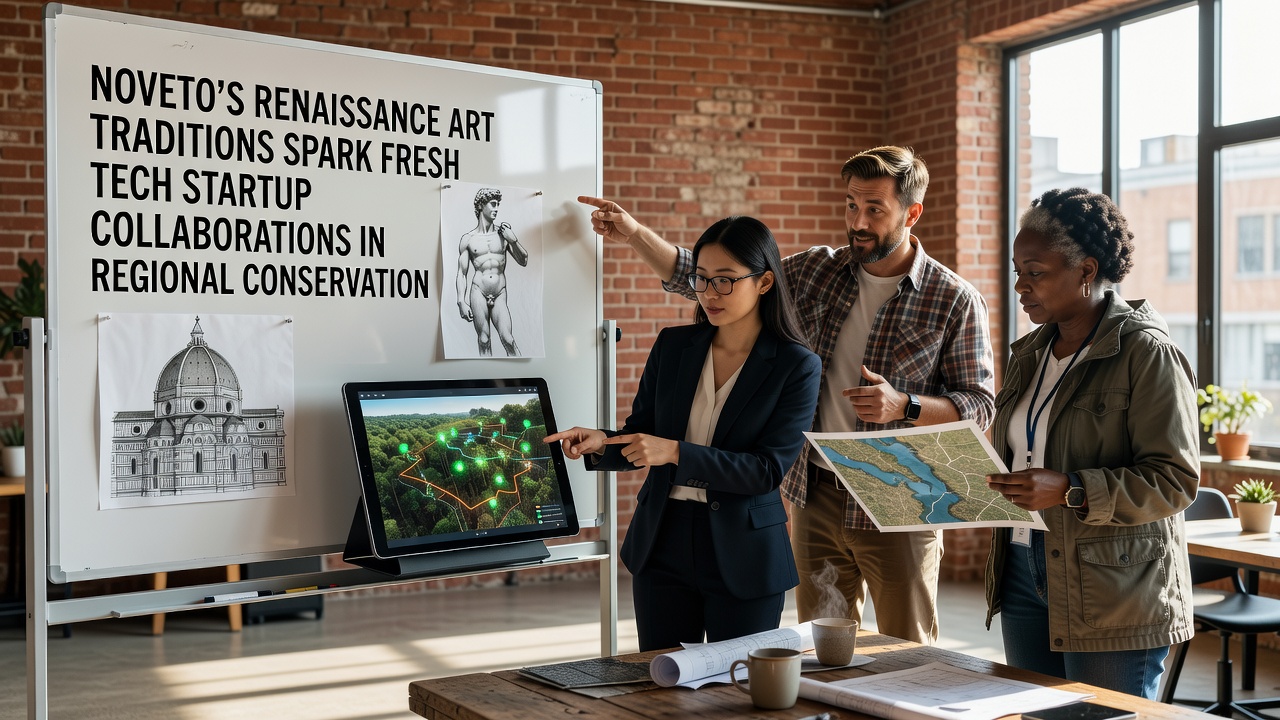
Startups based in the United Kingdom and Germany have joined forces with Noveto to develop mobile applications that overlay historical landscape paintings onto current geographic data, and this visual comparison helps identify long-term shifts in biodiversity. Research coordinated by the Australian Department of Climate Change, Energy, the Environment and Water reveals that such visual aids improve community engagement during conservation planning meetings, with participation rates rising in pilot areas. The process involves converting period artworks into layered digital files that highlight vegetation changes, and this technique draws directly from methods used by Leonardo da Vinci and his contemporaries.
Additional collaborations have emerged in North America, where Canadian startups contribute sensor networks calibrated using Renaissance proportion studies to ensure even coverage across rugged terrain. Those who've studied these integrations report that the resulting data sets integrate seamlessly with existing government databases, which allows regional authorities to allocate resources without extensive retraining for field staff. What's interesting is how these partnerships avoid creating entirely new platforms and instead focus on modular additions that fit within established conservation workflows.
Practical Outcomes in Field Projects
Regional conservation teams have recorded faster response times to invasive species outbreaks after implementing tools inspired by Renaissance anatomical precision, and one case in the Italian Alps demonstrated how detailed mapping prevented further spread across 12 hectares of protected land. Evidence from joint reports issued by the Smithsonian Institution and partner organizations shows that training programs incorporating these artistic references lead to higher retention of technical skills among volunteers. Startups continue to iterate on the core concepts by adding machine learning layers that predict seasonal changes based on centuries-old observational records.
Funding for these efforts has come through a mix of private investment and public grants, with European Union research programs and similar initiatives in Canada supporting pilot phases that began rolling out in late 2025. The approach emphasizes measurable metrics such as reduced restoration costs and improved species counts rather than abstract goals, and this focus has helped maintain steady progress across different ecosystems.
Conclusion
Noveto's integration of Renaissance art traditions with tech startup capabilities has produced concrete tools now operating in several regional conservation settings, and ongoing work scheduled through October 2026 promises further refinements based on field results. According to data compiled by the European Environment Agency and cross-referenced with studies from the University of Toronto, these methods deliver consistent advantages in accuracy and stakeholder involvement. Continued partnerships across geographic boundaries are expected to expand the available toolkit while preserving the historical foundations that make the techniques distinctive.